
Diagnostic visit
from $89
The lowest first-visit figure we publish anywhere, and the reason is the parts channel rather than the hour. One visit, one written answer, and the fee comes off the work when you go ahead.
Miami-Dade · Broward · Palm Beach
Almost nobody chooses this badge. It is what was already in the condominium when it was bought, what the landlord fitted, what the builder specified — and it wants to work again for a sensible number rather than to be admired. That shapes everything on this site: the figures start lower than anywhere else we work because the parts are on the van rather than on order, the free checks come before the visit, and where the honest answer is that nothing is wrong we would rather write it down than drive out to point at a setting.
Start from the appliance
11 appliance types, and each card says what the work on that one really is. The ice maker and the ice machine are two of them, because on this badge those are two different appliances — the module inside a refrigerator, and a countertop cabinet with a reservoir you fill by hand.
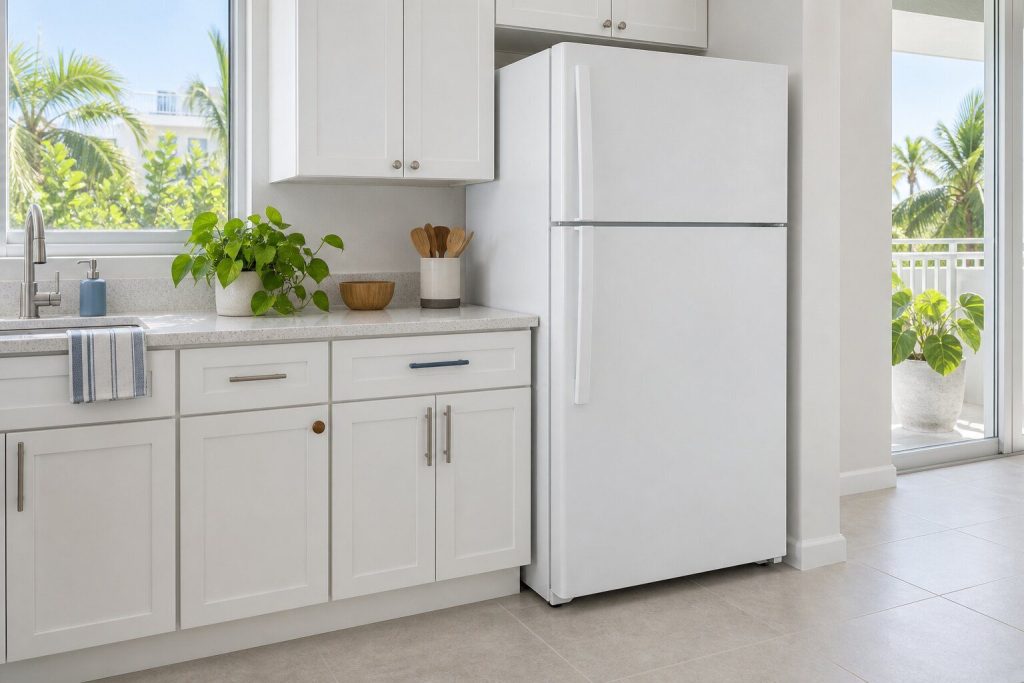
The deepest branch of this catalog by a distance: 142 cabinets, and the largest single family in everything Frigidaire currently sells is the plain top-freezer refrigerator — 55 of them. That number is the brand in one line. This is the refrigerator that came with the apartment, and half our calls are for a cabinet nobody chose. French door adds 44 and side-by-side 31, which is where the ice and water go wrong, and the two-cabinet compact and bottom-freezer families are small enough to name individually. In this climate the work concentrates on defrost, on door seals that never fully dry, and on condensers that live in salt air.
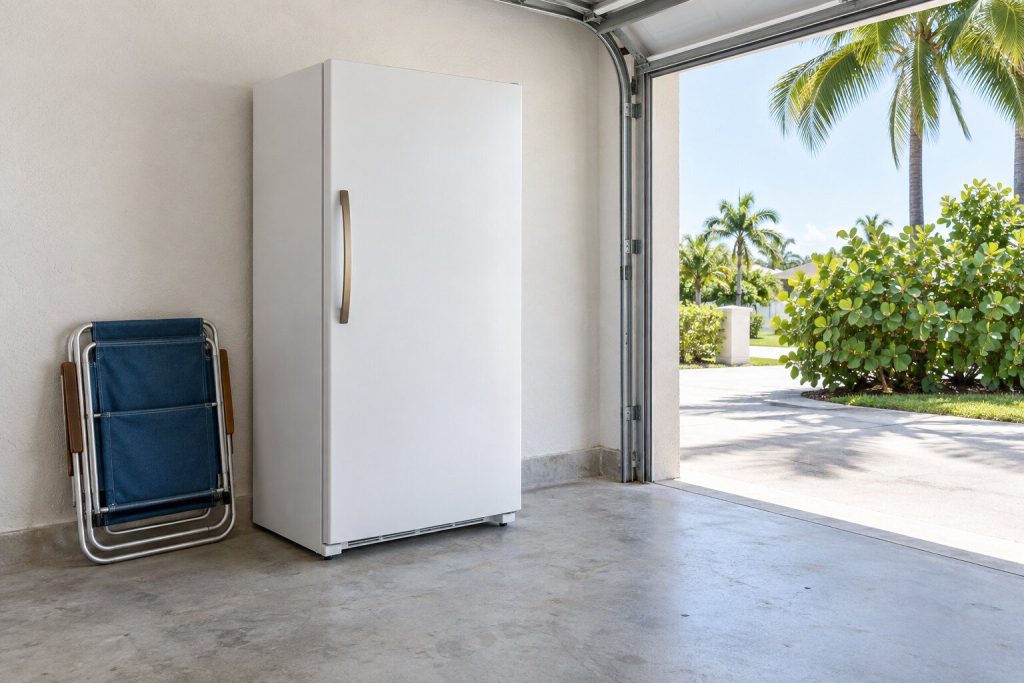
Twenty-seven cabinets, and unusually for a volume brand the upright is the bigger half — 17 against three chest freezers and a small single-door family. In South Florida a standalone freezer usually lives in a garage or a utility room rather than a kitchen, which changes both what goes wrong and what a visit involves: ambient temperature well above what the cabinet was rated for, a condenser breathing dust, and a door that gets opened with wet hands in August. A freezer that is quietly running warm is the failure that costs the most, because nothing announces it until the food is gone.
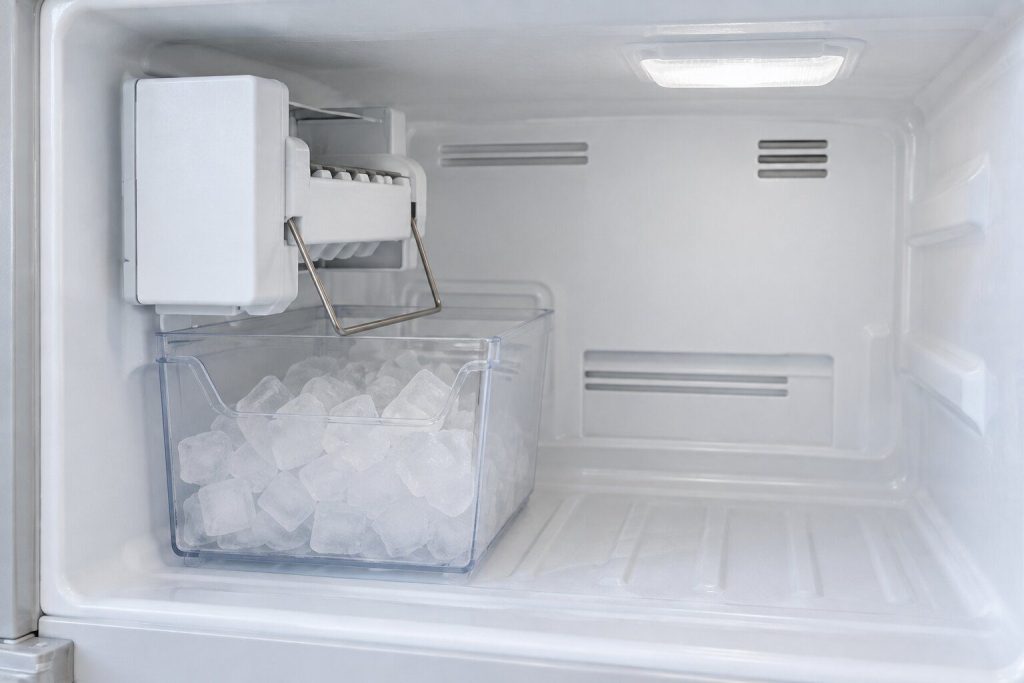
This page is about the ice maker inside the refrigerator, because that is where Frigidaire puts them. The catalog has no undercounter ice cabinet at all — the standalone machines are three countertop appliances, and they have their own page. What we are called out for here is the module in a French door or side-by-side cabinet: no ice, hollow or half-formed cubes, a bin that has frozen into one block, or a dispenser that grinds and delivers nothing. The water side of that circuit — filter, valve, line — causes more of it than the module itself.
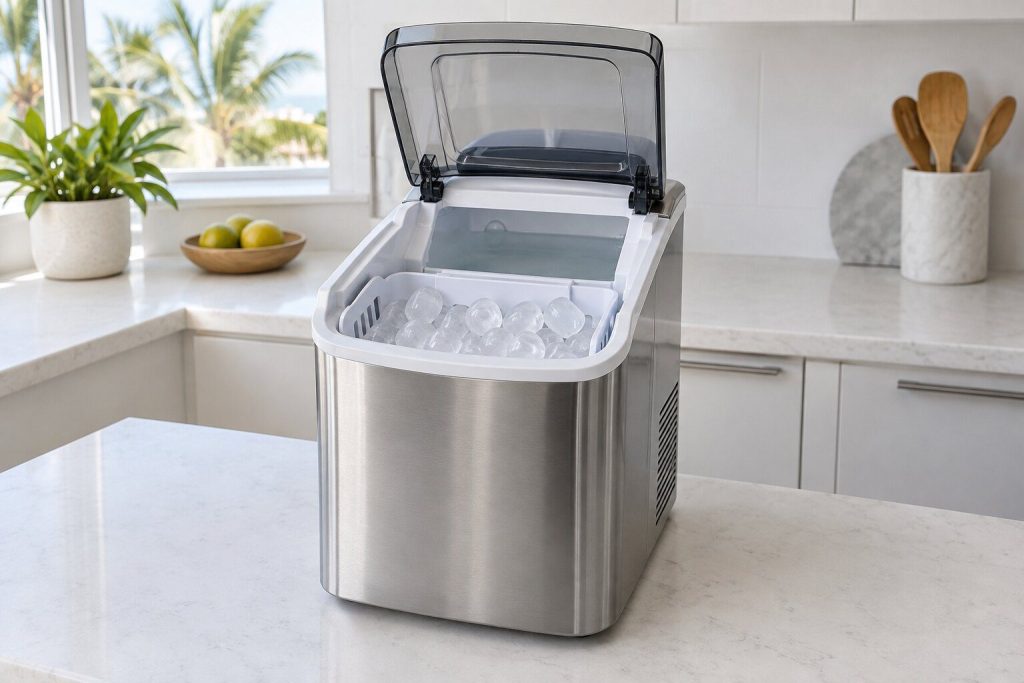
Three models, all of them countertop: a portable machine you fill from a jug that makes bullet ice in a few minutes. It is worth being exact about that, because the phrase 'ice machine' means an undercounter cabinet with a drain and a condenser on other makes in this trade, and Frigidaire builds none. These are small appliances with a pump, a compressor, an evaporator of steel fingers and a water reservoir, and they fail in small-appliance ways: scale, a pump that has lost prime, a sensor that thinks the basket is full.
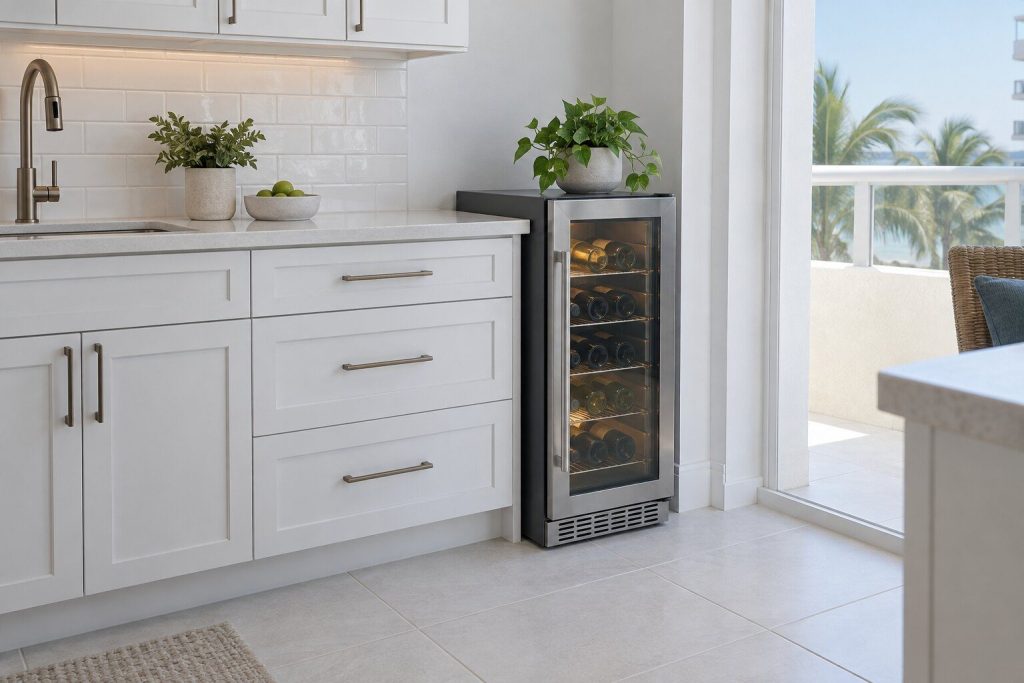
Seven cabinets, and they are beverage centers and wine storage rather than the multi-zone cellars the luxury makes in this fleet sell. They go under a counter or into a bar run, they are usually glass-doored, and in South Florida they spend the year fighting the room: warm ambient, a glass door that gains heat, and a compressor sized for a small cabinet. The complaints follow from that — not holding temperature in the afternoon, condensation on the inside of the glass, a fan that has become loud.
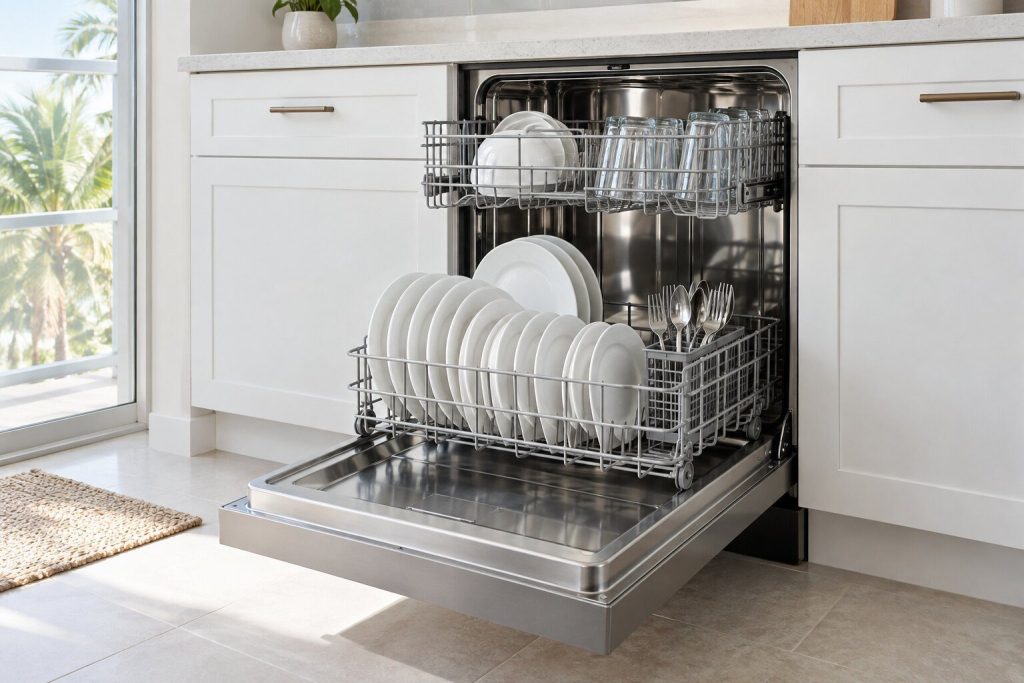
Thirty-six machines, from the plain front-control model that fills a builder's kitchen to the Gallery and Professional trims with a third rack. This is the appliance where the difference between series is smallest: the same platform, a different fascia and a quieter tub. What we attend is consistent because of that — not draining, not cleaning, not drying, and water where it should not be. The filter and the spray arms account for more of it than any electrical part does, which is why the first questions are about what is at the bottom of the tub.
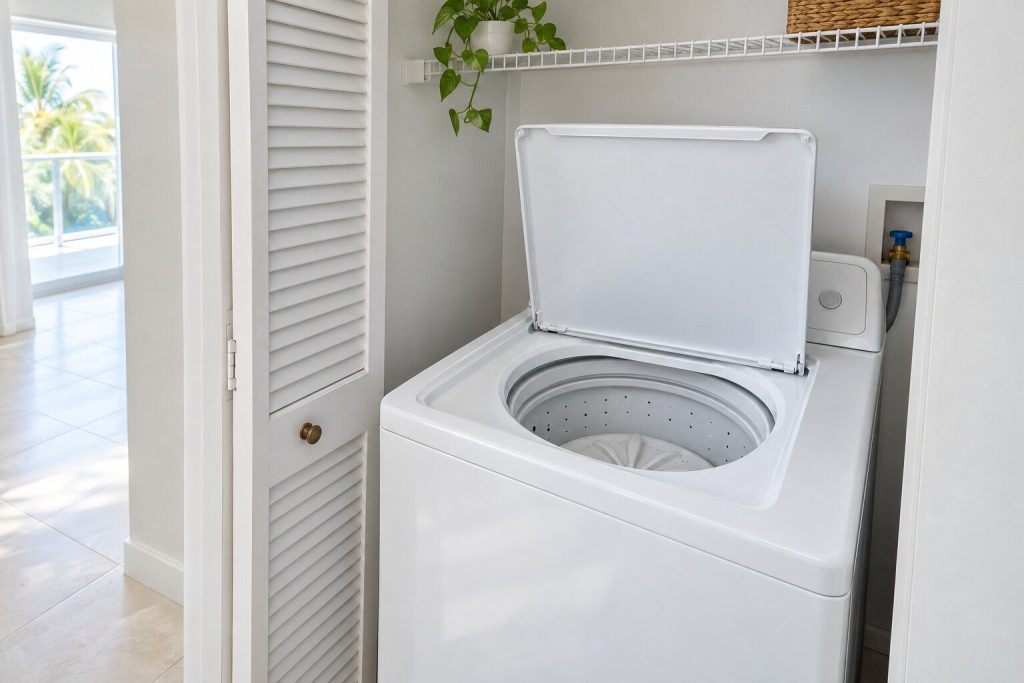
The current catalog carries two top-load washers and three laundry centers, and that thinness is worth saying out loud: Frigidaire's laundry line today is a fraction of its kitchen line. What we open in South Florida is mostly older — front-loaders from the years the badge sold them in volume, top-loaders in condominium closets, and stacked laundry centers in apartments where nothing else fits. The failures are the ones that come with age and with this climate: bearings, seals that never dry, pumps that meet a lint load nobody clears, and drains that back up in a shared stack.
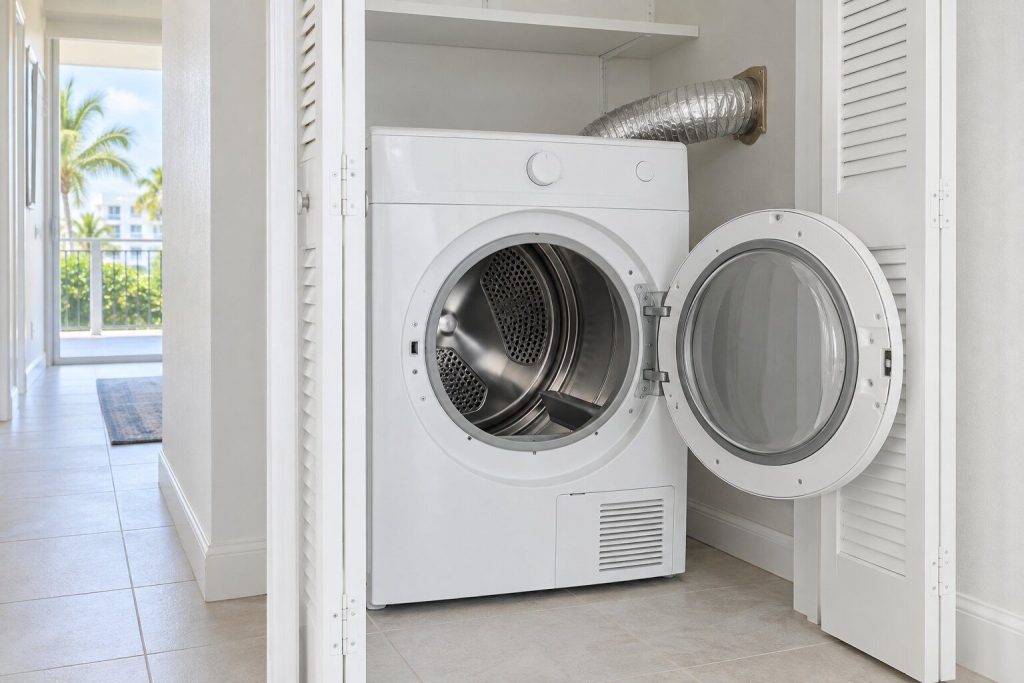
Four dryers and three laundry centers in the current line, and every one of them vented — there is no heat-pump dryer under this badge. In South Florida the vent is most of the story: a duct that runs further than it should, through a wall into a corridor or up through a building, collecting lint at every bend. A dryer that takes two cycles to dry a load is almost never a broken dryer, and saying so before selling a part is the difference between a repair and a sale. The genuine problems, when they come, are the element or the burner, the thermostat and the cutout, the drum rollers and the belt.
South Florida
When the machine does say something
Every one is traced to a single article of this maker's own owner support library, and the page links it. That archive is small on purpose rather than by omission: it documents conditions for four kinds of machine and publishes nothing whatever for its dryers, its freezers, its wine cabinets or its ice machines. Where it names a code and offers no mechanism behind the name — which is most of the range's F-codes — the page prints its instruction and says so, instead of a plausible guess.
A short code, and the appliance that gives it meaning
Photograph the display before you reach for the breaker. This maker's own answer to most of these is thirty seconds at the fuse box, and that is also how the evidence gets thrown away.
Three shapes this make reports in
Five we are called about most, and what each is actually saying
| i20 | A dishwasher that did not drain. The maker's own list starts with the knockout plug in the garbage disposal, and in a kitchen fitted to a schedule that plug is left in often enough to be the first suspect. |
|---|---|
| E4 | A washer that felt the load piled to one side and stopped rather than walking across the floor. Installation first — shipping supports and a cabinet not resting firm — and after that it is one comforter. |
| F10 | An oven reading a temperature higher than the one it was asked for, and stopping itself. A protection working rather than a part failing, and the one on this list not to keep resetting past. |
| H | A refrigerator that has been warm for long enough to say so. The highest temperature it reached is shown when the alert is acknowledged — write that number down, because clearing the alarm discards it. |
| CL | Not a failure at all: the control lock is on and the lid has been open too long. It reaches us because a locked panel reads as a dead machine to anybody who did not switch the lock on. |
Each has its own page under the appliance it belongs to, because the same characters on a washer and on a range are two different repairs. Type what you can see into the index and it will take you to the right one.
Photograph the panel first and reset second. A code that clears and stays clear was a condition rather than a failure; one that returns has a part behind it, and repeated resets only postpone the same visit.
All 23 conditionsNothing is listed for a dryer, a freezer, a wine cabinet or an ice machine, because this maker publishes nothing for them — no table, no list, no article. On those the symptom pages carry the whole diagnosis, written as measurement rather than as translation.
How a visit goes
The model and serial off the rating plate, and a photograph of the panel if there is anything on it. The serial matters as much as the model on this badge, because this maker revises parts inside a model run — and the name on the door does not help: Frigidaire, Gallery and Professional are trim levels on one platform.
A washer that will not respond may be locked. A dishwasher counting down from a number under twenty-five has a delay start somebody set by accident. A cabinet with no lights and a dead panel is often in Sabbath mode. None of those is a repair, and we would rather say so on the phone than take the fee for pointing at a padlock symbol.
Parts, availability and labor, in writing. Nothing is ordered or fitted until you have said yes, and the diagnostic comes off the bill when you do. A second problem found while the machine is apart is quoted rather than quietly carried out.
The parts channel behind this badge is the widest we work with: pump, valve, element, lid switch and fan motor are stocked rather than ordered. That is why the diagnostic here is the lowest figure we publish anywhere — the trip that finds the problem does not have to carry the cost of a second one.
What it costs
46 jobs with a published starting figure and a page behind each saying what moves it. Nothing here is a quote and no final price appears anywhere on this site: the exact cost is measured at your machine and agreed in writing before anything is opened — including the cases where the arithmetic says the machine is finished.
from $89
The lowest first-visit figure we publish anywhere, and the reason is the parts channel rather than the hour. One visit, one written answer, and the fee comes off the work when you go ahead.
from $89
A countertop machine gone slow and cloudy is usually scaled rather than failing. South Florida water leaves a film on the evaporator fingers, and the film is an insulator — descaling is the whole repair in most of these.
from $109
The cheapest thing that can be done to a refrigerator here and the one most often skipped. The coil is behind a grille at floor level, which makes it easy to reach and easy for a year of dust to reach as well.
from $139
The most common call on this badge, and the layout narrows it: these are single-evaporator cabinets, so a warm fresh-food side over a healthy-looking freezer is a pointer to the air path rather than a puzzle.
from $185
Twelve induction ranges and eight cooktops are current products here, where several makes we work on build none. Half of what arrives as a failure is detection or airflow, and the page says which is which.
from $275
The one repair on this list we sometimes advise against. On a sealed tub the job is the tub, the drum and the seal together, and on a twelve-year-old machine the arithmetic often says no — which we would rather tell you at the diagnostic.
Every figure here is a starting point and a researched market band for South Florida, never a quote and never an invoice. The exact cost is confirmed after an on-site diagnostic and agreed with you in writing before anything is opened.
Every figure and what moves itWhere we work
59 cities and neighborhoods, each with a page saying what we actually see there. Tell us where you are when you book — and if it is a building with a service elevator and an association, say so, because that is half the scheduling on this badge.
Neighborhoods people ask for by name
Coverage is Miami-Dade, Broward and Palm Beach counties — the pages below are the places people search for by name, not the edge of where we drive.
A photograph of the display is ideal, taken before anybody cuts the power — on this make there is no way to ask the machine for a code again. Where there is nothing on the panel, tell us what the machine does and when it does it. You get the scope and the figure in writing before anything is opened.
This article is based on:
Before you call
On this badge the question is sharper than on most, because the appliance was inexpensive when it was new and nobody in the room chose it. Three things decide it and the year on the plate is not one of them. What the part is: a pump, a lid switch, a valve, an element or a sensor is a stocked commodity here and quick to fit, while a sealed-tub bearing or a bonded glass cooktop is neither. Whether the machine is built in — a wall oven or a laundry center carries an installation cost you would pay again on a replacement, so those usually earn the repair. And what else on it is already worn. Where the arithmetic says replace, you get the numbers rather than a shrug, and you have paid for the answer instead of for a part.
Almost never on this make, and the reason is the layout. The plain top-freezer is this maker's largest family and the side-by-side is close behind, and both cool from a single evaporator: one cold source, one fan, one air path, with the fresh-food section getting only what the freezer gives it. So a warm refrigerator over a freezer that still looks healthy is a pointer rather than a puzzle — a blocked air path, a stalled fan or a defrost circuit that has stopped. The hour goes there rather than to the sealed system.
Then this maker does not document it publicly, which is not the same as the code being invalid. Its owner support library covers four kinds of machine — the top-load washer, the dishwasher, the electric range and cooktop, and the refrigerator — and publishes nothing at all for dryers, freezers, wine cabinets or ice machines. Some codes are shown only on a service display and some belong to one model year. Tell us the model and exactly what the panel shows, and we will work from the behavior instead.
Rule out the control lock first, because it costs nothing and it is the commonest false alarm on this equipment. It is a deliberate feature, engaged by holding a pad, and a sleeve wiping a panel is how it usually gets switched on. On a refrigerator the equivalent is Sabbath mode, which disables the lights and the controls while the cooling carries on normally — a cabinet in it looks dead and is not. Both survive a trip to the breaker, which is exactly why people conclude the appliance has died.
Usually not, and it is worth knowing before anybody quotes a part. The three series are trim levels on one platform rather than different machines, so the badge predicts the finish, the handle and the panel and rarely predicts the evaporator, the pump or the board behind them. What does change the part is the serial: this maker revises components inside a model run, so two machines with the same model number and different serials can take different versions of the same component.
No. We are an independent repair company working in Miami, not affiliated with, authorized by or endorsed by any manufacturer, and we warrant our own workmanship rather than anybody else's. What we do have is 23 conditions read out of this maker's own owner support library and linked back to it page by page, 26 symptom pages for the machines it says nothing about at all, and 46 jobs with a published starting figure.